
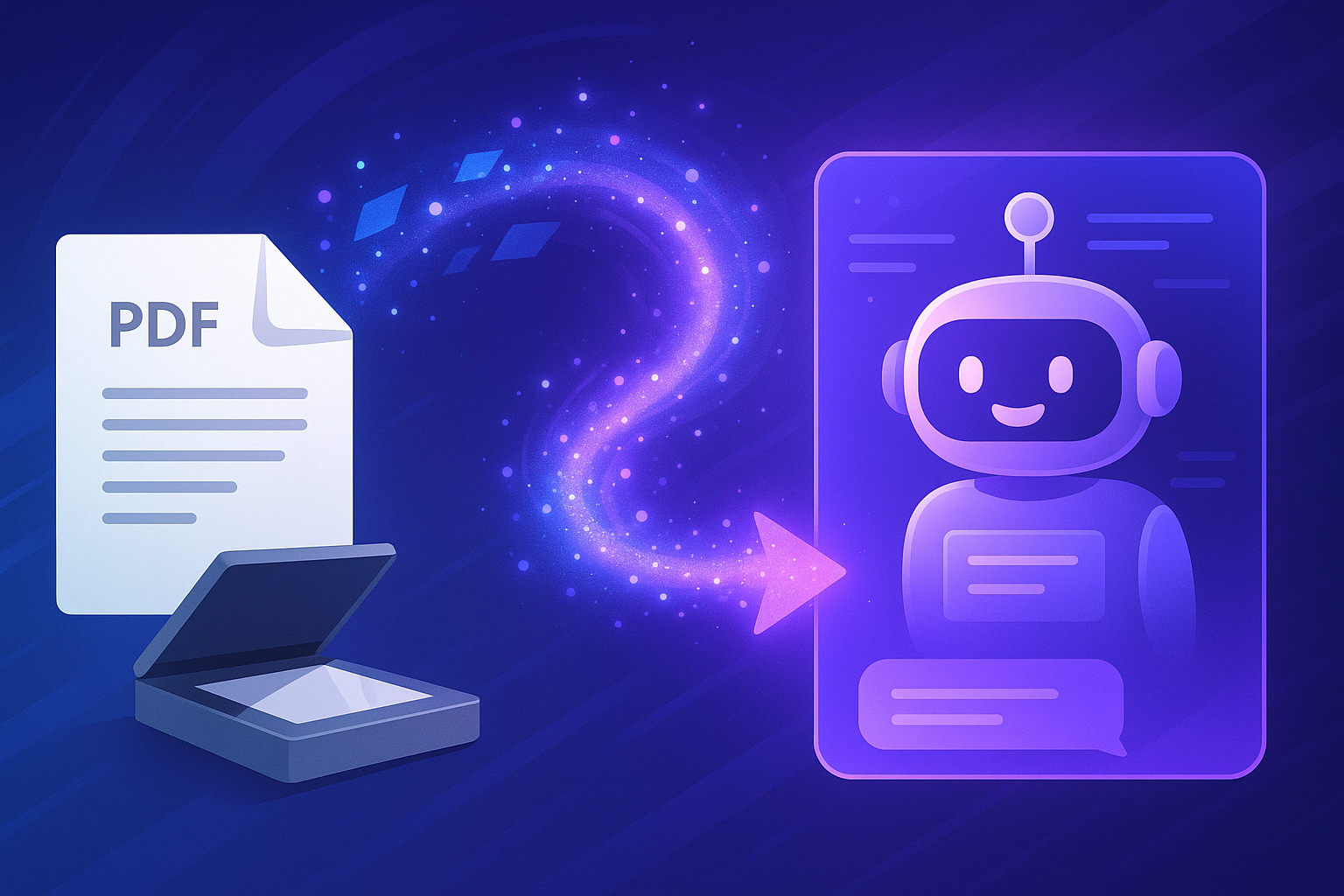

One-line: A Retrieval-Augmented Generation (RAG) PDF chatbot that ingests PDFs, indexes them with OpenAI embeddings, and answers user queries by retrieving relevant context and generating answers with a Llama-3 model served via Groq — orchestrated using LangChain.
What it does
Ingests PDF documents (single or batch), extracts text, cleans and splits into chunks.
Generates vector embeddings for each chunk using OpenAI embeddings.
Stores vectors in a vector store (e.g., FAISS, Chroma, Pinecone).
Uses LangChain to build a retrieval pipeline: given a user query, it retrieves top-k relevant chunks.
Feeds retrieved context + user query into a generative LLM (Llama 3 served on Groq) to produce grounded, citation-aware answers.
Returns responses in a conversational chat UI, optionally showing source citations and confidence/metadata.
Core components / tech stack
LangChain — orchestration, chains, prompt templates, retrieval QA.
PDF parsing —
pdfplumber/PyPDF2/pdfminer.sixfor text extraction.Text splitting / preprocessing — chunking, stopword removal, optional language detection.
Embeddings — OpenAI Embeddings API (or an alternative) to vectorize chunks.
Vector store — FAISS / Chroma / Pinecone / Milvus for fast similarity search.
LLM — Llama-3 hosted/accelerated on Groq hardware (inference endpoint).
Frontend — simple chat UI (Streamlit / Flask / React) to interact with the bot.
Optional — job queue (Redis/RQ), Docker, Kubernetes for scalability.
High-level flow
Upload PDF → extract text → split into chunks.
Create embeddings for chunks (OpenAI) → store vectors in chosen vector DB.
User asks question → retrieve top relevant chunks via similarity search.
Construct prompt (retrieved chunks + instructions) → call Llama-3 (Groq) to generate answer.
Return answer + sources; log conversation for future improvements.
Features to highlight
Grounded answers using retrieved document context (minimizes hallucinations).
Source citations (link to page/chunk + excerpt).
Hybrid retrieval options: semantic + keyword filtering.
Configurable prompts and chain-of-thought toggles.
Batch ingestion and incremental indexing for updates.
Access controls and usage logging for privacy/compliance.
Deployment & Ops notes
Use OpenAI only for embeddings if you require best-in-class semantic vectors; consider local/open replacements for offline setups.
Host Llama-3 inference on Groq for high-throughput low-latency serving; ensure prompt format and tokenization match model specifics.
Secure API keys, enforce rate limits, and implement caching for repeated queries.
Monitor vector-store size and re-chunking strategy for large corpora.
Limitations & improvements
RAG quality depends on chunk size, embedding quality, and retrieval strategy.
Llama-3 may still hallucinate—mitigate with stronger prompt engineering, answer verification, and grounding heuristics.
Consider answer ranking ensemble (multiple prompts or models) and user-feedback loop to improve accuracy.